





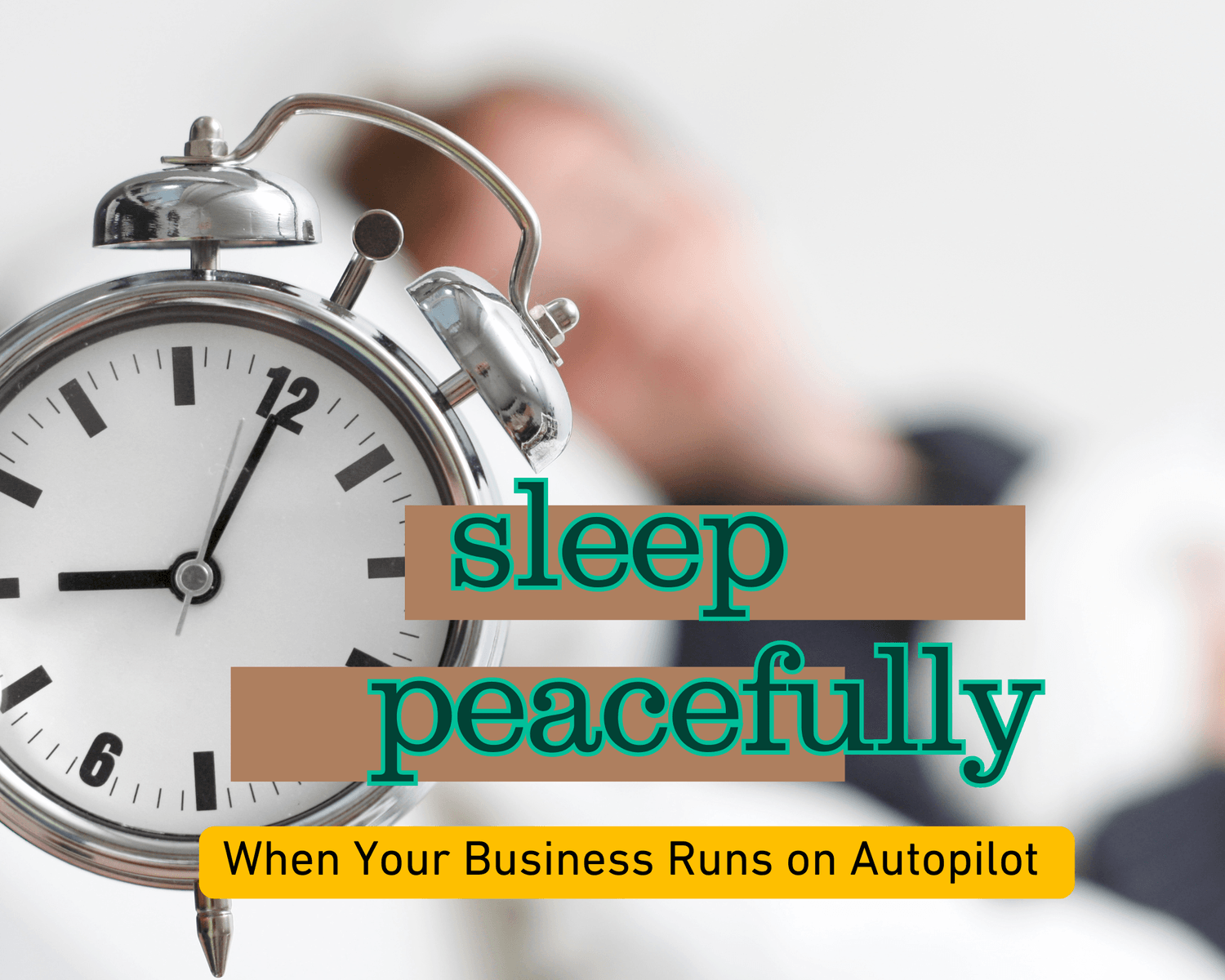
How to Sleep Peacefully When Your Business Runs on Autopilot (The Psychology of Letting Go)
Every successful entrepreneur knows this uncomfortable truth: building automated systems is easy - trusting them enough to actually step back is terrifying.
Right now, as you read this, your business might be running smoother than ever. Sales funnels converting. Customer service responding. Operations humming along. But you're still checking your phone at 2 AM, refreshing dashboards during family dinner, and lying awake wondering if everything is "really" working.
The painful reality? Most business owners who've successfully automated their operations still operate from a place of constant anxiety rather than confident leadership.
You didn't build automated systems to create a more sophisticated prison. You built them to buy back your time, reduce your stress, and create the mental freedom to think strategically about your business future.
The breakthrough isn't building better systems—it's transforming your psychology from an anxious controller to a confident leader who trusts what they've built.


The Hidden Leadership Trap:
Your Autopilot Anxiety
Your business systems are running beautifully. The problem isn't technical—it's psychological. Here's the mental prison most automated business owners create for themselves:
The Confidence Paradox
Hypervigilance: You monitor systems more obsessively than when you did everything manually
Decision Paralysis: You second-guess automated decisions that are actually working
Control Addiction: You intervene in processes that don't need your involvement
Trust Deficit: You believe systems will fail without your constant oversight
The Leadership Anxiety
Your automation anxiety isn't just about systems—it's about your identity as a leader. When processes run without you, when decisions happen automatically, when problems get solved without your input, you wonder: "What's my role now? Am I still needed?"
The Mental Exhaustion
You've automated the work but not the worry. You're physically removed from operations but mentally still trapped in every detail. The result? You're more stressed about your business than before you automated it.
The Real Cost: How Autopilot Anxiety Destroys Your Leadership
When you can't trust your automated systems, the impact goes far beyond lost sleep:
Immediate Leadership Impact
Strategic Blindness: You're so focused on monitoring operations that you miss bigger opportunities
Team Demoralization: Your constant intervention signals you don't trust your people or processes
Decision Fatigue: You're making hundreds of micro-decisions that should be automated
Innovation Paralysis: You can't explore new directions because you're trapped managing existing systems
Personal Life Destruction
Family Tension: You're physically present but mentally always "at work"
Health Decline: Chronic stress from constant monitoring takes a physical toll
Relationship Strain: Partners and friends feel like they're competing with your business for attention
Identity Crisis: You've lost connection to why you started the business in the first place
Business Growth Stagnation
Scaling Impossibility: You can't grow because you won't step back from current operations
Leadership Bottleneck: Every decision flows through you, limiting organizational capability
Strategic Vacuum: You're so busy monitoring tactics that you ignore strategic planning
Innovation Drought: New ideas get crushed under the weight of operational obsession
The truth? Your autopilot anxiety isn't just limiting your freedom—it's actively sabotaging your business potential.
The 7 Psychological Barriers Keeping You
Trapped in Operational Anxiety
1. The "What If" Spiral
You've automated customer service, but you constantly wonder: "What if a customer has a unique problem? What if the system gives the wrong response? What if we lose a valuable client because I wasn't personally involved?"
2. The Control Addiction
You built systems to give you freedom, but you can't stop checking them. Every notification becomes urgent. Every variation in metrics becomes a crisis. You're more enslaved to your dashboard than you ever were to manual processes.
3. The Perfectionism Trap
Your automated systems work 95% of the time, but you obsess over the 5% of edge cases. You can't accept that imperfect automation is still better than perfect manual processes you can't scale.
4. The Identity Crisis
If your business runs without you, who are you as a leader? If systems make decisions, what's your value? If processes happen automatically, what's your purpose? You stay involved not because you're needed, but because you need to feel needed.
5. The Trust Deficit
You believe your systems will fail without constant monitoring. You've never given them a chance to prove their reliability because you intervene at the first sign of any variation from expected results.
6. The Responsibility Overwhelm
You feel personally responsible for every customer interaction, every process outcome, every system decision. You've automated the work but not the weight of responsibility, so you carry the burden of everything that happens in your business.
7. The Fear of Irrelevance
Deep down, you're afraid that if your business truly runs on autopilot, you'll become irrelevant. So you create reasons to stay involved, problems to solve, and crises to manage—not because they exist, but because you need them to exist.
The Transformation: From Anxious Controller to Confident Leader
True business autopilot isn't about better systems—it's about better psychology. It's the mental shift from needing to control everything to trusting what you've built to work without you.
1. Trust-Based Leadership
Instead of monitoring every system output, you focus on system design and strategic direction. You lead by setting parameters and measuring outcomes, not by controlling individual processes.
2. Strategic Perspective
With operational anxiety removed, you can see opportunities your competitors miss. You spend time on market analysis, strategic partnerships, and innovation rather than dashboard monitoring.
3. Confident Delegation
You trust your systems and your people to handle what they were designed to handle. You intervene only when strategic decisions are needed, not when operational variations occur.
4. Mental Freedom
You can be fully present in your personal life because you're not mentally running your business 24/7. You've reclaimed your time and your peace of mind.
5. Identity Evolution
You've shifted from business operator to business architect. Your value isn't in doing the work—it's in designing systems that do the work better than you ever could manually.
Your Path to Autopilot Confidence: The Psychological Transformation
Ready to transform from anxious controller to confident leader? Here's the proven psychological transformation process:
Phase 1: Anxiety Assessment and Awareness
We identify exactly what's keeping you mentally trapped in operational details. Most business owners discover their anxiety isn't about system failures—it's about identity and control.
What We Analyze:
Your current monitoring behaviors and trigger points
The emotional stories you tell yourself about "what might happen"
Your leadership identity and how it's tied to operational involvement
The specific fears keeping you from trusting your systems
Phase 2: Trust Building Through Systematic Testing
We create controlled environments where you can safely experience your systems working without your intervention, building confidence through evidence rather than hope.
What We Implement:
Gradual "hands-off" experiments with clear success metrics
Backup systems that give you psychological safety during testing
Documentation of system reliability to combat "what if" thinking
Trust-building exercises that prove your systems' capability
Phase 3: Identity Transformation and Role Redefinition
We help you evolve from business operator to business architect, finding fulfillment in strategic leadership rather than operational control.
What We Develop:
A new leadership identity based on strategic value rather than operational involvement
Clear boundaries between strategic decisions (your role) and operational execution (system role)
Fulfillment sources that don't require constant business monitoring
Leadership activities that leverage your unique strategic capabilities
Phase 4: Mental Freedom and Life Integration
We create psychological structures that allow you to be fully present in your personal life without anxiety about business operations.
What We Establish:
Mental boundaries between "leader time" and "personal time"
Confidence-building routines that reinforce system reliability
Anxiety management techniques for when operational concerns arise
Life integration practices that don't require business monitoring
Phase 5: Strategic Leadership and Growth Optimization
We don't just free you from operational anxiety—we redirect that energy toward strategic opportunities that actually grow your business.
What We Focus On:
Strategic planning and market opportunity identification
Innovation projects that leverage your freed-up mental capacity
Leadership development that multiplies your impact beyond operations
Growth strategies that utilize your automated foundation
The Mental Freedom You Deserve: Life After Autopilot Confidence
When you truly trust your automated systems, you're not just saving time—you're reclaiming your life and leadership potential:
For Your Leadership
Strategic Focus: 80% of mental energy spent on growth opportunities instead of operational monitoring
Decision Quality: Better strategic decisions because you're not overwhelmed by operational details
Innovation Capacity: Mental space to explore new directions and opportunities
Leadership Presence: Confidence that comes from trusting your systems and your people
For Your Personal Life
Family Presence: Fully engaged in personal relationships without business anxiety
Health Recovery: Reduced stress levels and better sleep quality
Identity Freedom: Self-worth not tied to constant business monitoring
Life Balance: Time and energy for personal interests and relationships
For Your Business Growth
Scaling Capability: Systems that truly run without your involvement, enabling growth
Strategic Advantage: Competitive edge from focusing on big-picture opportunities
Innovation Pipeline: Mental capacity to develop new products, services, and strategies
Leadership Multiplication: Your reduced operational involvement allows others to grow
For Your Peace of Mind
Sleep Quality: Genuine rest without 2 AM phone checking
Mental Clarity: Reduced anxiety and decision fatigue
Confidence Security: Trust in your systems and your strategic leadership
Future Optimism: Excitement about business possibilities rather than operational fears
Your Next Step: Claim Your Mental Freedom Today
Every day you stay trapped in operational anxiety, you're missing strategic opportunities. Your business deserves a leader who thinks about the future, not someone who monitors the present.
You didn't build automated systems to create a more sophisticated prison. You built them to buy back your time, reduce your stress, and create the mental freedom to think strategically about your business future.
It's time to stop accepting that "anxiety is just part of entrepreneurship" and start experiencing what happens when you truly trust what you've built.
The difference between entrepreneurs who scale and entrepreneurs who stay trapped isn't the quality of their systems—it's their ability to psychologically step back and lead strategically.
Ready to transform from anxious controller to confident leader? Book a time with us!
POST CATEGORY
Grow with your VA
Get early access to our new service by registering your interest





2025 Grow with your VA